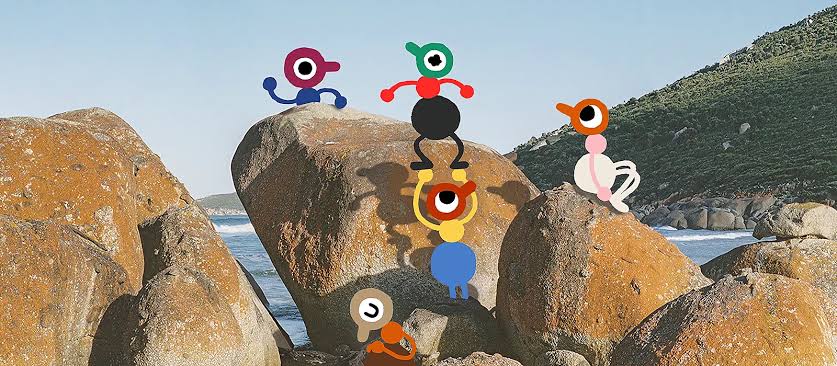
Big Walk has quickly become one of the most talked-about indie games of August 2026. Developed by Australian studio House House, the team behind Untitled Goose Game, the new title takes a very different approach by focusing almost entirely on cooperative exploration, communication, and the simple pleasure of getting lost with friends. The game launched on August 4, 2026, for PC, PlayStation 5, and Nintendo Switch 2.
The concept sounds surprisingly simple. Players enter a large open environment together, walk around, solve puzzles, discover unusual locations, and figure out how to communicate when conventional conversation is not always available. Yet that simplicity is exactly where Big Walk finds its personality.
Rather than constantly pushing players toward combat, upgrades, or complicated objectives, the game treats social interaction itself as part of the experience.
A Co-Op Game Built Around Communication
Big Walk is designed specifically as a cooperative multiplayer experience. Players need to work together to navigate the environment and solve challenges, while various tools and mechanics occasionally change the way they can communicate.
That structure creates plenty of situations where confusion becomes part of the fun.
One player may understand what needs to happen while another is standing somewhere completely different. A seemingly straightforward puzzle can quickly turn into a chaotic conversation involving gestures, improvised directions, and questionable teamwork.
It is this unpredictability that makes Big Walk feel less like a traditional puzzle game and more like a digital road trip with friends.
The puzzles are important, but the memorable moments often happen between them.
Exploration Without Constant Pressure
One of Big Walk’s biggest strengths is its relaxed approach to exploration.
The world gives players room to wander rather than constantly directing them toward the next objective. Steam describes the game as a cooperative online “walker-talker” where players can explore, solve puzzles, or simply spend time together.
There are moments when players may stop progressing entirely just to investigate something strange in the distance or mess around with one of the game’s interactive objects.
That freedom gives the adventure a surprisingly natural rhythm.
Big Walk understands that multiplayer games do not always need to fill every second with action. Sometimes the most entertaining part is simply watching friends make bad decisions.
Read next: Looking for more standout PC games this month? Explore our latest gaming coverage for new Steam releases, indie recommendations, major updates, and other titles worth adding to your August 2026 playlist.
House House Keeps Its Trademark Humor
Anyone familiar with Untitled Goose Game will probably recognize House House’s sense of humor almost immediately.
Big Walk is not built around nonstop jokes or scripted comedy. Instead, much of its humor emerges naturally from player behavior and the game’s deliberately playful mechanics.
Players can steal objects from friends, interfere with what they are doing, or turn an otherwise simple task into unnecessary chaos.
The official description even highlights activities such as stealing a friend’s binoculars and throwing them into the ocean, which gives a fairly accurate impression of the game’s personality.
The result is comedy that feels spontaneous rather than forced.
Strong Critical Reception
Big Walk has also attracted considerable critical attention since launch.
The game rapidly became one of the highest-rated releases of 2026 on Metacritic, while several major outlets praised its cooperative design and ability to make casual interaction feel meaningful.
PC Gamer described it as a cooperative puzzle game centered around exploring an island with friends, while GamesRadar highlighted how its puzzles adapt as additional players join the group.
The positive reception is significant because Big Walk does not rely on the usual blockbuster formula.
There are no enormous skill trees, cinematic combat sequences, or endless lists of equipment to collect. The core experience instead depends on whether players enjoy spending time with the people in their group.
That makes Big Walk unusual, but it also explains why the game has connected with so many players.
It Works Best With the Right Group
The game’s strongest feature can also become its biggest limitation.
Big Walk is fundamentally designed around multiplayer interaction. Someone looking for a traditional solo adventure may therefore find its structure far less appealing.
The quality of the experience can also depend heavily on the people joining the session.
With a group of friends willing to experiment, communicate, and occasionally behave like complete idiots, Big Walk can produce memorable moments that would be difficult to recreate in a more scripted game.
With less communicative teammates, some of that magic may disappear.
Still, that dependency feels intentional rather than accidental. Big Walk is not simply a game that happens to include cooperative multiplayer. Friendship and communication are effectively its central mechanics.
A Refreshing Break From Competitive Multiplayer
Modern multiplayer games often revolve around rankings, competitive performance, seasonal rewards, or constant progression.
Big Walk moves in the opposite direction.
There is little pressure to prove that someone is the best player in the group. The focus is instead on discovery and cooperation.
That approach makes the game feel particularly refreshing for players who want a multiplayer experience without the stress commonly associated with competitive online titles.
The world becomes a playground rather than a battlefield.
Verdict: Simple Idea, Surprisingly Memorable
Big Walk succeeds because it understands something many multiplayer games overlook: players often remember the people they played with more clearly than the objective they completed.
House House builds almost the entire experience around that idea.
Its puzzles encourage cooperation, its open spaces reward curiosity, and its playful mechanics regularly create moments that feel unique to each group.
The game may not be ideal for players searching for a deep single-player campaign or action-heavy experience. But for anyone with a few friends looking for something unusual to play together, Big Walk stands out as one of August 2026’s most interesting releases.
Its strong critical reception suggests that a game does not need endless complexity to make an impression. Sometimes all it takes is a strange world, a few puzzles, and several friends who probably should not be trusted with binoculars.
Want to discover more standout games beyond Big Walk? Check out our latest gaming coverage for fresh Steam releases, indie highlights, upcoming titles, and other games worth playing in August 2026 on the Hebohwin99 platform.