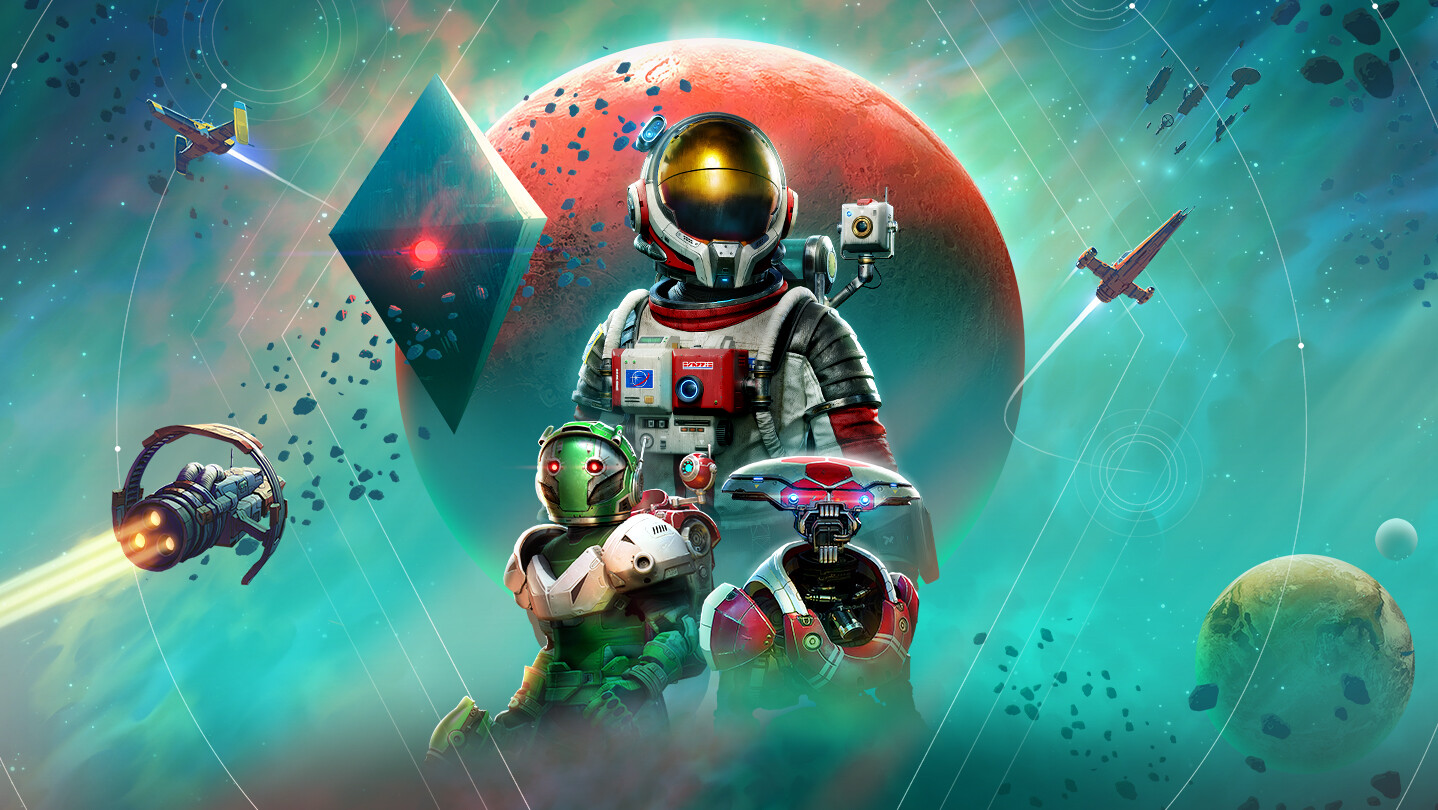
Ten years after its original release, No Man’s Sky is almost unrecognizable compared with the game that arrived in 2016. Hello Games has spent a decade expanding its procedural universe with base building, multiplayer, freighters, settlements, expeditions, customizable starships, improved planetary generation, and increasingly ambitious community events.
In its current 2026 form, the game feels less like a conventional campaign and more like a massive science-fiction playground. Steam currently rates recent reviews as Very Positive, with around 90 percent of recent players leaving positive feedback.
Exploration Remains Its Greatest Strength

The strongest feeling in No Man’s Sky still comes from leaving a planet, flying into orbit, selecting another star system, and continuing the journey with minimal interruption.
Its procedurally generated universe contains planets with different climates, creatures, resources, terrain, oceans, and environmental hazards. The enormous scale means there is almost always somewhere new to visit.
However, procedural generation also creates repetition. Experienced players will eventually recognize familiar structures, resource loops, and creature combinations. The game delivers extraordinary scale more effectively than handcrafted environmental detail.
Exploration Score: 9.4/10
Building and Starships Add Long-Term Appeal
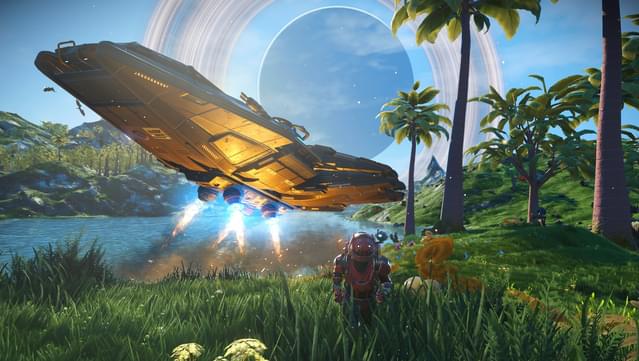
The game becomes much more rewarding when players choose their own priorities.
Some may build elaborate planetary bases, while others focus on trading, collecting unusual starships, managing freighters, discovering creatures, or participating in Expeditions.
The Voyagers update significantly expanded starship customization by introducing Corvette-class vessels. These enormous ships can be assembled from individual modules, furnished inside, shared with friends, and used as genuine multi-crew spacecraft.
It adds another layer of creativity, although inventory management and the number of upgrade systems can initially feel intimidating.
Creativity Score: 9.5/10
2026 Updates Keep Changing the Game
Hello Games has continued adding substantial content during the game’s tenth-anniversary year.
February’s Remnant update introduced the Gravitino Coil, a gravity-based Multi-Tool module that can lift and throw objects. It also expanded salvage gameplay with customizable hauling vehicles and waste-processing activities.
Later updates pushed the sandbox in completely different directions. Xeno Arena introduced creature battling, while May’s The Swarm update added faction-based community objectives and enormous space battles against the Hive of Glass and swarms of robotic enemies.
That constant evolution remains one of the game’s biggest strengths.
Combat Is Fun but Still Secondary
Both ground and space combat have improved significantly over the years. Players can fight Sentinels, pirates, hostile creatures, and increasingly large enemy formations.
The Swarm makes space encounters especially impressive by placing huge numbers of ships into the same battles.
Still, shooting lacks the precision of dedicated action games, while starship combat remains fairly accessible rather than deeply technical.
Combat works best as another activity inside the sandbox instead of the primary reason to play.
Combat Score: 7.7/10
Multiplayer Makes the Universe Feel Alive
Modern No Man’s Sky is far less lonely than its earliest version.
The Space Anomaly provides a multiplayer hub, while missions, Expeditions, shared bases, Corvette crews, and community events encourage cooperation. The Voyagers update specifically expanded multiplayer possibilities aboard customizable ships.
The galaxy remains enormous enough for long periods of solitude, but players now have significantly more control over whether they want a peaceful solo journey or a social space adventure.
No Man’s Sky Review Scores
| Category | Score |
|---|---|
| Exploration | ⭐⭐⭐⭐⭐ — 9.4/10 |
| World Variety | ⭐⭐⭐⭐½ — 8.8/10 |
| Base Building | ⭐⭐⭐⭐⭐ — 9.2/10 |
| Starship Systems | ⭐⭐⭐⭐⭐ — 9.3/10 |
| Combat | ⭐⭐⭐⭐ — 7.7/10 |
| Multiplayer | ⭐⭐⭐⭐½ — 8.7/10 |
| Visual Atmosphere | ⭐⭐⭐⭐⭐ — 9.2/10 |
| Replay Value | ⭐⭐⭐⭐⭐ — 9.5/10 |
| Newcomer Accessibility | ⭐⭐⭐⭐ — 7.8/10 |
| Overall Rating | ⭐ 4.5/5 — 9.0/10 |
Alternative Rating
Exploration Freedom: A+
Combat Depth: B
Creativity: A+
Replay Value: A+
Learning Curve: B-
Long-Term Support: S
Final Grade: A
Final Verdict No Man’s Sky
No Man’s Sky still has weaknesses. Resource gathering can become repetitive, procedural worlds eventually reveal familiar patterns, and newcomers may feel overwhelmed by years of accumulated systems.
Yet very few games provide this much freedom. Players can construct a home on an alien planet, build a personalized Corvette, explore with friends, salvage wreckage using a gravity gun, battle strange creatures, or join massive community space conflicts—all within the same universe.
After ten years of expansion, No Man’s Sky earns 9.0/10. It is no longer defined by what it failed to deliver at launch. In 2026, it stands as an enormous, creative, and remarkably persistent science-fiction sandbox.