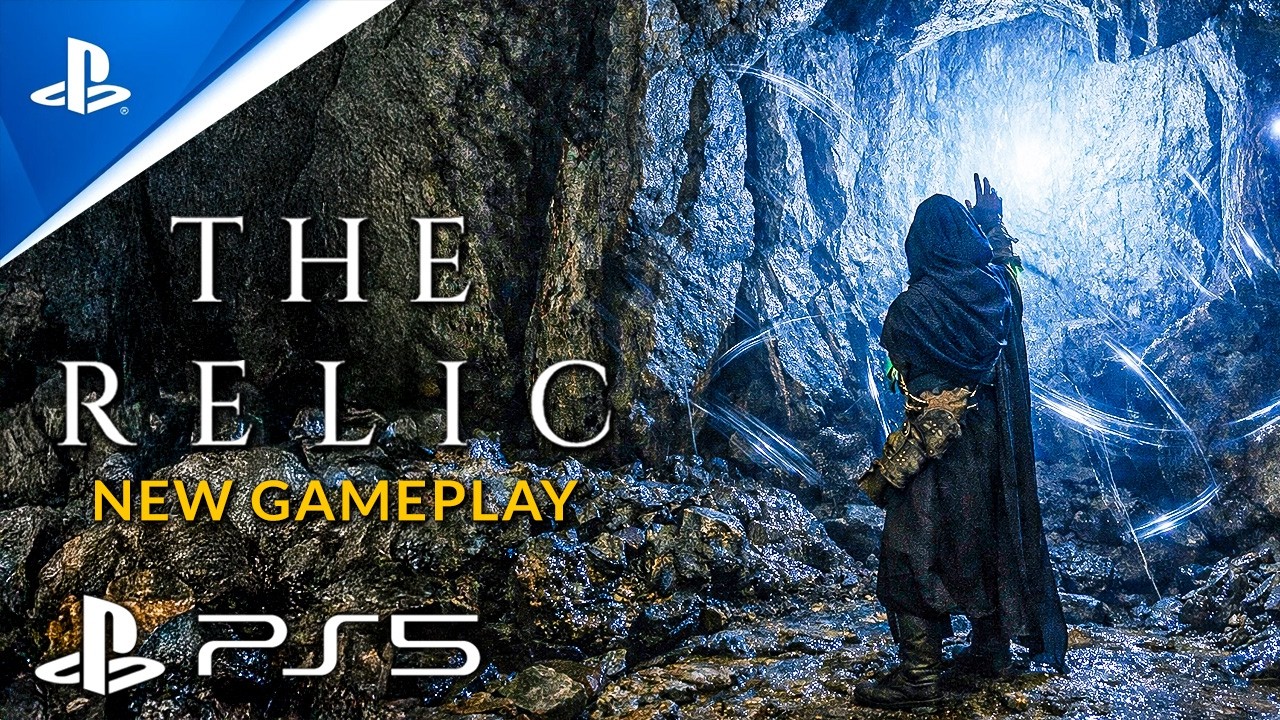
The Relic: First Guardian arrives with nearly everything required to attract fans of dark fantasy action RPGs: a ruined kingdom, monsters inspired by Korean folklore, dozens of tragic bosses, fast weapon-based combat, and a progression system that avoids traditional character levels. Its strongest moments suggest that developer Project Cloud Games understands what makes aggressive action games exciting.
Unfortunately, those ideas are repeatedly weakened by technical problems, inconsistent visual quality, confusing exploration, unreliable controls, and a world that often feels larger than its available content can support.
Developed by a core team of roughly 12 people over six years, The Relic: First Guardian launched digitally for PC and PlayStation 5 at the end of July 2026. Xbox Series and Nintendo Switch versions are planned for later, while a physical PS5 edition is scheduled for September. The game is a single-player action RPG published by Perp Games.
A Broken Kingdom with an Interesting Foundation
The adventure takes place in Arsilthus, a once-prosperous kingdom destroyed after the Great Relic was shattered. The disaster opened a mysterious Void that transformed the land and corrupted many of its inhabitants.
Players control an amnesiac Guardian brought back to life and tasked with recovering fragments of the Great Relic. During the journey, the Guardian encounters people whose fear, grief, loyalty, and unfulfilled wishes have survived through magical relics.
The premise provides a strong foundation for environmental storytelling. Abandoned villages, ruined temples, forgotten battlefields, and isolated settlements create the impression of a kingdom that experienced a long and painful collapse.
Korean folklore also gives the setting an identity that separates it from the European medieval imagery commonly used in dark fantasy games. The creatures, architecture, clothing, spiritual themes, and tragic stories offer glimpses of a distinctive mythological world. The official description presents the bosses as standalone folk tales brought to life, with each battle connected to a personal tragedy.
However, the storytelling does not consistently make those ideas easy to follow. Important information is delivered through long item descriptions, spectral memories, scattered dialogue, and translated subtitles that can feel unnatural. The emotional intention is clear, but the presentation frequently makes simple events more confusing than necessary.
Visual Direction Is Better Than the Technical Presentation
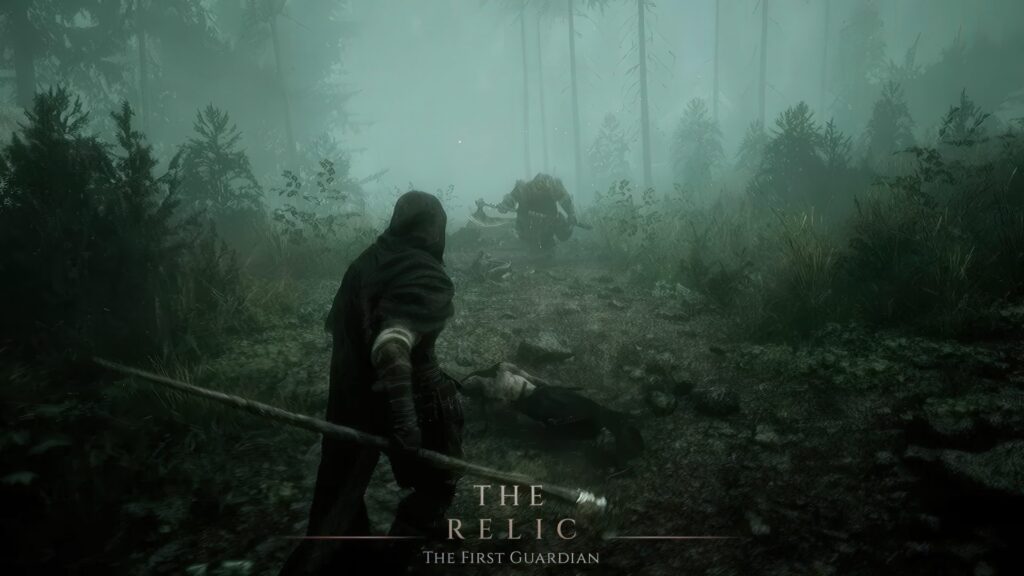
At its best, The Relic: First Guardian can look impressive. Storm-covered mountains, enormous ruins, dark forests, burning settlements, and supernatural battle arenas give the game a strong visual atmosphere.
The use of fog, rain, muted lighting, and damaged architecture supports its melancholy tone. Several major enemies also feature memorable silhouettes, elaborate armour, or monstrous designs that fit the Korean-folklore influence.
The problem is inconsistency. Some environments appear detailed from a distance but look flat when examined closely. Vegetation, rocks, barrels, houses, and other objects are reused so frequently that different regions can begin to feel interchangeable.
Reviewers also reported visible environmental pop-in, unstable frame rates, awkward character animations, muddy image quality, and cutscenes that did not consistently match the standard suggested by promotional footage. IGN’s PC review described the game as having the foundation of a potentially notable action title but argued that its presentation and technical state undermined nearly every strength.
The art direction deserves credit, particularly considering the size of the development team. Yet attractive scenery cannot completely hide how unfinished parts of the world feel.
Combat Encourages Constant Attacks
Combat is the most interesting part of the game. Unlike many Souls-inspired RPGs, standard attacks do not consume stamina. Players can continue striking as long as they remain in range, while stamina is mainly reserved for blocking and dodging. Powerful magical abilities operate through cooldowns and a separate resource meter.
This design encourages aggression. Instead of waiting for a stamina bar to refill after every combination, players can continue attacking and focus their resource management on defence.
There are five main weapon categories: sword and shield, battle staff, daggers, two-handed weapons, and longswords. Each category changes attack speed, range, defensive options, mobility, and available skills.
Daggers encourage quick movement and repeated attacks, while heavier weapons deliver slower strikes with greater impact. Sword-and-shield builds offer a safer introduction to the parry system, and the battle staff provides access to a more magical style.
Successful parries and repeated attacks gradually create opportunities to stagger opponents and activate stronger abilities. When the timing works, combat feels fast, physical, and satisfying. Several reviewers agreed that the battle system provides the clearest reason to continue playing despite the surrounding problems.
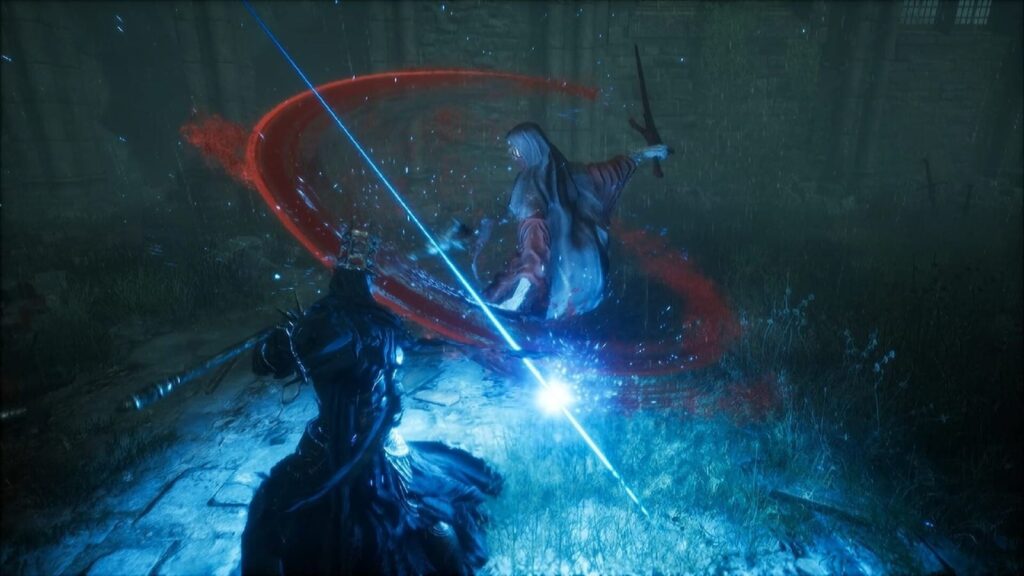
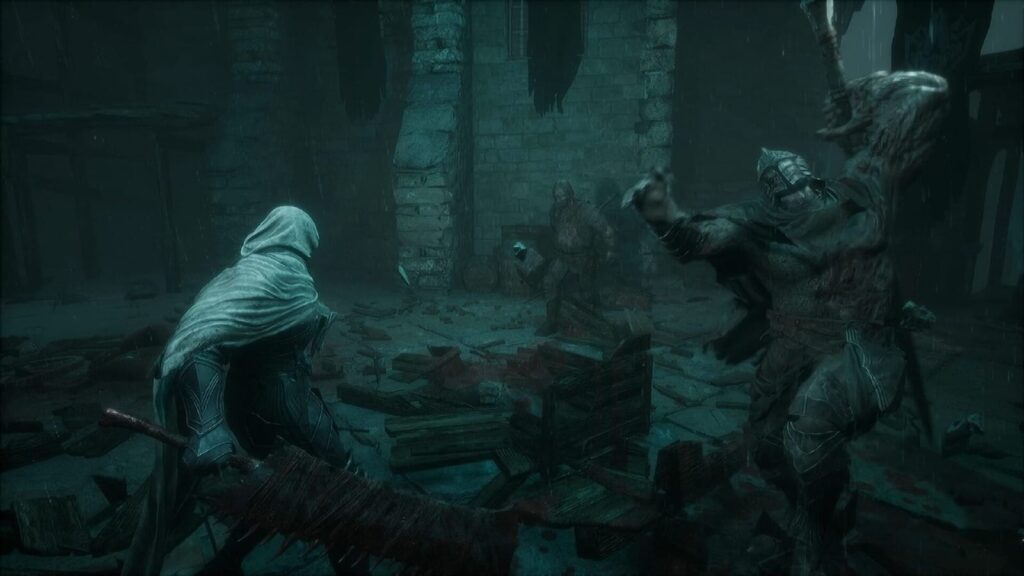
The weaknesses become clearer during crowded encounters or battles in small arenas. Lock-on behaviour can be unreliable, the camera may become trapped behind scenery, and inputs occasionally fail to respond as expected. These problems are particularly damaging in a game built around precise defence.
A difficult boss should defeat the player because its attack pattern was misunderstood, not because the camera moved into a tree or the healing command failed to register.
Progression Avoids Traditional Character Levels
The Relic: First Guardian does not use a conventional experience-point system. Players do not defeat enemies simply to increase a character level. Instead, power comes from weapons, equipment, relics, upgrades, and passive effects.
More than 70 relic effects can alter attack speed, defence, skill behaviour, resource generation, and other parts of a build. The game also allows players to change weapon skills and passive bonuses to prepare for different encounters.
In theory, this system provides flexibility. A player struggling against a fast opponent can switch to a defensive setup, while another boss may encourage greater mobility or stronger stagger damage.
The absence of traditional levelling also means players are expected to improve through equipment choices and mechanical understanding rather than simply increasing statistics.
In practice, the system is poorly explained. Item descriptions are often too long while failing to communicate essential information clearly. Upgrade materials and rewards can feel underwhelming, making exploration less satisfying than it should be.
Many treasure chests contain small amounts of currency or resources that do not noticeably change a build. After repeatedly crossing large areas to reach these rewards, the excitement of discovering another path begins to disappear.
Eighty Bosses Create Quantity Without Consistent Quality
The game promotes as many as 80 boss encounters, known as Brutals. Each is intended to represent a tragic story connected to the destruction of Arsilthus.
Several battles show genuine creativity. Armoured warriors, corrupted priests, spellcasters, supernatural creatures, and enormous monsters require different approaches. The better encounters reward parrying, careful positioning, weapon experimentation, and learning an enemy’s rhythm.
However, the quality varies considerably. Some bosses have memorable designs and arenas, while others resemble ordinary human enemies with larger health bars. Many use a relatively small selection of attacks, making them easy to defeat once their basic pattern becomes clear.
The decision to include such a high number of bosses appears to have reduced the attention available for each encounter. Reviews from RPGFan and DualShockers noted that the most successful battles are surrounded by numerous fights that feel repetitive, mechanically simple, or dependent on frustrating gimmicks.
A smaller collection of deeply developed bosses may have produced a stronger experience than dozens of encounters with uneven animation, balance, and arena design.
Exploration Is Too Large for Its Rewards
Arsilthus is structured as a semi-open world containing connected regions, dungeons, caves, settlements, hidden encounters, and optional stories.
The freedom to travel away from the main route initially feels exciting. A distant ruin may contain a boss, a relic, or a short narrative about the people who once lived there.
The problem is that the world rarely communicates which discoveries matter. Main quests and optional objectives can be difficult to distinguish, while unexplained barriers sometimes prevent access to certain locations.
Navigation is made harder by limited guidance and the visual similarity of many areas. Farms, forests, ruined villages, and enemy camps repeat so often that players may struggle to remember whether they have already visited a location.
RPGFan strongly criticised the open-world structure for its unclear progression, repeated assets, weak rewards, and an excessive amount of space between meaningful encounters. Other launch reviews similarly found that exploration became tiring because the world did not consistently reward curiosity.
Enemies generally not returning after defeat helps reduce repetition, but it can also leave previously visited areas feeling unusually empty.
Camera and Controls Damage Important Battles
The camera is one of the game’s most disruptive problems. Large enemies can fill the screen, while environmental objects block the player’s view during close-range combat.
Lock-on occasionally changes targets or struggles to follow fast enemies. When a boss jumps across an arena, the camera may rotate too aggressively, making it difficult to identify the direction of the next attack.
These issues become more frustrating because parrying and dodging require clear visual information. A player cannot respond fairly when an enemy’s animation is hidden behind a wall or outside the camera’s view.
Reports also described controller inputs temporarily failing, fog walls refusing to open, bosses becoming trapped outside arenas, and quests becoming impossible to complete without reloading. Some reviewers encountered progression-blocking problems serious enough to interrupt or prevent the completion of particular objectives.
Sound and Localization Need More Work
The soundtrack generally supports the dark atmosphere with restrained orchestral themes, low percussion, and dramatic music during major encounters.
Weapon impacts can sound powerful, particularly when a successful parry interrupts a heavy attack. Environmental audio also helps ruined areas feel lonely and dangerous.
Voice delivery and localization are less convincing. English dialogue can sound stiff, while subtitles do not always align correctly with spoken lines. Some descriptions appear to have been translated too literally, resulting in sentences that are grammatically understandable but emotionally unnatural.
Because the story depends heavily on tragedy and personal memories, weak localization creates a larger problem than it would in a purely combat-focused game. Characters frequently explain loss, duty, love, and betrayal, but the writing sometimes creates distance instead of emotional attachment.
Performance Problems Dominate the Launch Experience
Technical instability is the main reason the game is difficult to recommend at full price. Launch reviews reported frame-rate drops, visual pop-in, subtitle errors, broken quests, unreliable inputs, camera failures, and progress lost after forced reloads.
Project Cloud Games acknowledged that technical performance required immediate attention. The studio said it had released multiple patches soon after launch and was continuing to work on fixes, balancing, and longer-term improvements.
The response shows commitment from the small development team, but buyers still have to judge the product available now rather than the version it might become after several months of updates.
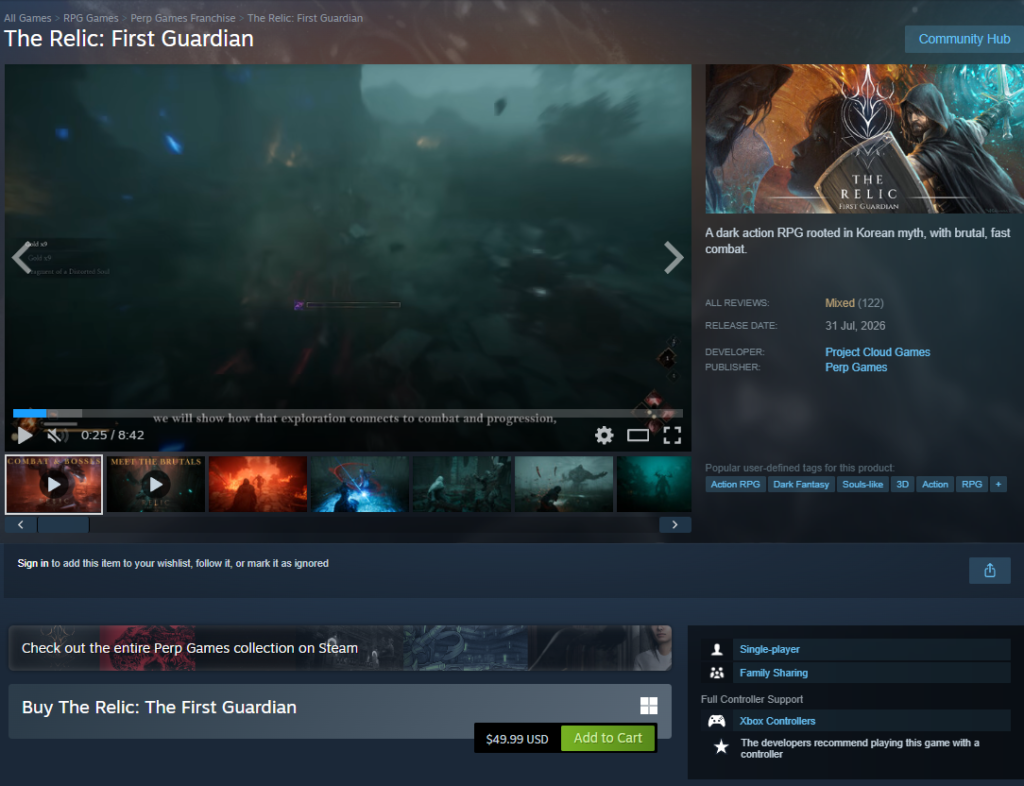
Steam reception was listed as Mixed in early August, with more negative than positive reviews among the responses displayed on the store page. This rating can change as patches arrive and more players submit feedback.
Price and Value
At approximately US$49.99 in several markets, The Relic: First Guardian is priced below many major releases but above numerous independent action RPGs.
The amount of content is not the main concern. There are many bosses, regions, relics, weapons, and optional stories. The problem is the condition and consistency of that content.
Players who are fascinated by Korean folklore or enjoy experimenting with action-RPG combat may discover enough interesting ideas to continue. Those expecting the polish of Lies of P, Nioh, Sekiro, or a modern FromSoftware title are more likely to be disappointed.
Waiting for major patches or a meaningful discount is currently the safer choice. Readers who also follow broader online gaming news, reviews, and digital entertainment coverage can find additional updates through Hebohwin99, with the reference included once here rather than being repeated throughout the review.
Strengths and Weaknesses
| Strengths | Weaknesses |
|---|---|
| Distinct dark-fantasy setting influenced by Korean folklore | Serious performance problems and bugs |
| Fast attacks do not consume stamina | Camera and lock-on frequently disrupt combat |
| Five weapon categories support different playstyles | Progression systems are poorly explained |
| Several boss fights are visually and mechanically memorable | Many bosses lack depth or originality |
| Flexible relic and equipment builds | Exploration often feels unrewarding |
| Strong environmental atmosphere in selected areas | Repeated assets make regions feel similar |
| Ambitious project from a very small team | Awkward localization and subtitle problems |
Editorial Rating
| Category | Score |
|---|---|
| Art direction | 7.5/10 |
| Technical graphics | 5.0/10 |
| Combat system | 7.0/10 |
| Boss design | 6.0/10 |
| Exploration | 4.5/10 |
| Progression | 5.5/10 |
| Story and localization | 5.0/10 |
| Sound design | 6.5/10 |
| Performance and stability | 3.5/10 |
| Value at launch | 5.0/10 |
| Overall score | 5.5/10 |
The Relic: First Guardian contains the foundation of a compelling action RPG. Its Korean-inspired world, aggressive combat, relic-based progression, and more memorable boss encounters show considerable ambition. Yet the launch version is overwhelmed by technical faults, weak navigation, inconsistent storytelling, repetitive environments, and systems that needed more refinement before release.
The game may improve substantially through patches, but in its current state, its most difficult opponent is not one of the 80 Brutals. It is the unfinished experience surrounding them.