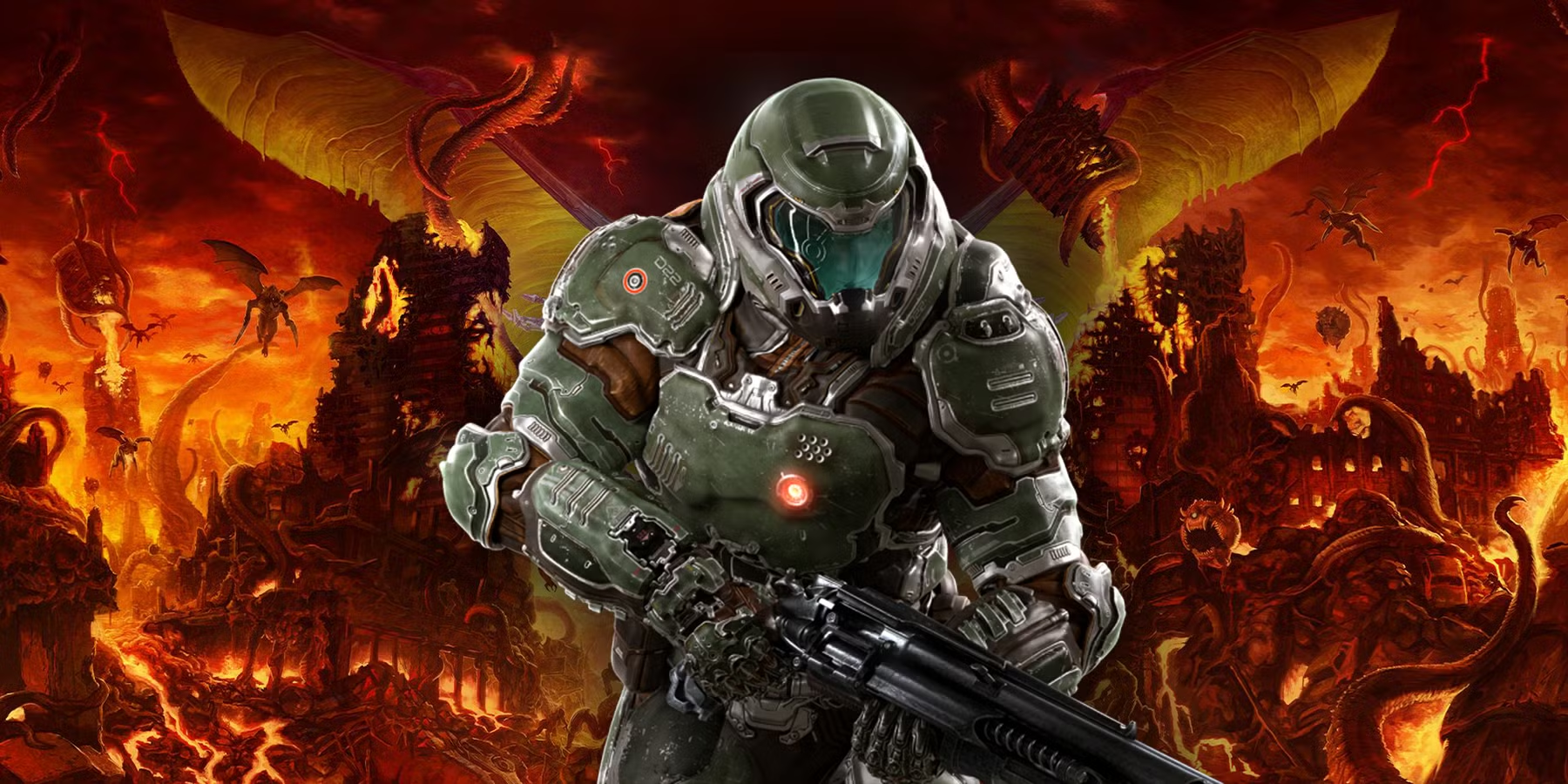
Mick Gordon has built a reputation for creating some of the most aggressive and instantly recognizable music in modern video games. His work on Doom and Doom Eternal helped shape the identity of both games, combining crushing guitar tones, distorted electronic textures, and relentless rhythms that matched the intensity of the action.
However, Gordon does not describe his creative process as simply writing music for a game. Instead, he views each new project as something waiting to be discovered.
The Australian composer compares his role to that of a musical archaeologist. Rather than arriving with a fixed sound and forcing it onto a project, Gordon carefully studies the game’s world, gameplay, visual direction, and emotional character. From there, he begins uncovering the music he believes already exists inside the experience.
For Gordon, the soundtrack is not an additional layer placed on top of a game. It is part of the game’s identity, buried beneath its imagery, mechanics, and atmosphere.
How Mick Gordon Discovers Music Instead of Forcing It
Gordon’s approach begins with listening and observation. Every franchise has its own history, visual language, and emotional rhythm, which means each project requires a different musical response.
He sees the composer’s job as carefully revealing those hidden sounds rather than relying on familiar formulas. In his view, the correct music already exists somewhere within the creative DNA of a game. The challenge is finding it, refining it, and presenting it in a way that feels natural.
This philosophy helps explain why his work on Doom felt so closely connected to the gameplay. The soundtrack did not simply accompany the combat. It seemed to move with the player, becoming heavier and more intense as battles escalated.
The music communicated the same ideas as the gameplay: speed, aggression, danger, and unstoppable momentum.
Gordon has said that a franchise such as Doom naturally inspires this kind of powerful musical direction. A series built around overwhelming demons, brutal weapons, and fast-paced combat would not be properly served by music that felt cautious or restrained.
Mick Gordon and the Sound That Redefined Modern Doom
When Doom launched in 2016, its soundtrack quickly became one of the game’s defining features.
Gordon combined heavily processed guitars with industrial noise, synthesizers, and experimental audio production. The result was a sound that was clearly influenced by metal but did not feel limited by traditional genre conventions.
Rather than recording a standard collection of guitar riffs, Gordon developed a complex production system involving analog equipment, signal routing, distortion, and layers of electronic processing. Harsh noises were reshaped into rhythmic and musical elements.
This process gave the soundtrack a mechanical quality that matched the game’s science-fiction environments. The music sounded heavy and violent, but it also felt connected to the machinery, technology, and demonic energy surrounding the player.
The soundtrack was especially effective because it responded to the action. During exploration, the music could remain tense and restrained. Once combat began, additional layers entered the mix, increasing the pressure and encouraging the player to keep moving.
This relationship between music and gameplay helped make the soundtrack feel interactive rather than passive.
How Mick Gordon Built a Soundtrack Around the Player
Game music presents challenges that are different from composing for film or television.
A movie follows a fixed timeline. The composer knows when a character will enter a room, when an explosion will occur, and when a scene will end. Video games are less predictable because players control the pace.
One player may complete an encounter quickly, while another may spend several minutes moving around the same area. The soundtrack must be flexible enough to support both experiences without creating obvious interruptions.
Gordon’s work on Doom used layered compositions that could change according to the player’s situation. The music became more aggressive during combat and eased back when the danger had passed.
That system helped create the impression that the soundtrack was reacting directly to the player’s behavior.
The result was not merely background music. It became part of the feedback loop that made combat feel satisfying. The player attacked enemies, the music intensified, and the increased energy encouraged even more aggressive movement.
Mick Gordon’s Fans Gave the Music a Life Beyond the Games
The popularity of Gordon’s Doom music continued long after players finished the campaigns.
Tracks from the games spread through streaming platforms, live performances, workout playlists, covers, remixes, and online videos. Some listeners became familiar with the music without ever playing the games themselves.
Gordon gives much of the credit for that longevity to the audience.
Once he completes a soundtrack and sends the audio to a developer, his direct involvement eventually comes to an end. The game is released, and the future of the music is then shaped by the way players and listeners respond to it.
In Gordon’s view, fans deserve significant recognition for keeping the soundtracks alive. Their enthusiasm, repeated listening, and creative reinterpretations allowed the music to grow beyond its original purpose.
This relationship between artist and audience is especially important in gaming culture. Players often form deep emotional connections with soundtracks because the music becomes tied to their own experiences.
A certain track may remind someone of a difficult boss fight, an unforgettable location, or the moment they finally completed a major challenge. These personal memories give game music a life that cannot be fully controlled by its composer.
Why Mick Gordon’s Doom Music Remains So Memorable
The enduring appeal of Gordon’s Doom soundtrack comes partly from how completely it supports the game’s central fantasy.
Players are not encouraged to hide or wait for enemies to approach. They are pushed into constant movement, close-range attacks, and aggressive decision-making. The music reinforces that behavior through tempo, rhythm, and sound design.
The soundtrack also avoids feeling too polished. Its rough textures and distorted tones fit a world filled with damaged technology, ruined facilities, and supernatural violence.
There is a sense of controlled chaos in the music. Every sound feels dangerous, but the composition remains focused enough to guide the player through the action.
That balance is difficult to achieve. Music that is too chaotic can become exhausting, while music that is too structured may fail to communicate the intensity of the gameplay.
Gordon’s compositions operate between those extremes, delivering noise, power, and rhythm without losing their identity.
Mick Gordon’s Music Is More Than Heavy Guitars
Although Gordon is strongly associated with metal-influenced game music, reducing his work to loud guitars would overlook much of what makes it distinctive.
His soundtracks often rely heavily on experimentation. Synthesizers, unusual signal chains, electronic pulses, industrial textures, and processed recordings play major roles in the final sound.
The guitar is only one part of a much larger system.
This willingness to experiment allows Gordon to create music that feels specifically connected to the fictional world of a game. Instead of choosing instruments only because they belong to a certain genre, he focuses on what kinds of sounds could plausibly exist inside that universe.
For a futuristic and violent game such as Doom, that meant combining human performance with machine-like processing.
The final compositions often feel as though they were generated by the game’s environments themselves. The music sounds like machinery overheating, metal collapsing, signals becoming corrupted, and enormous systems operating beyond their limits.
Mick Gordon’s Role as a Musical World Builder
Gordon’s archaeological comparison also highlights the importance of world-building in game music.
A successful soundtrack helps players understand a setting before the story explains everything. Instruments, rhythm, and production choices can communicate whether a world is ancient, futuristic, peaceful, unstable, or dangerous.
Music can also reveal information about characters and factions. A disciplined military group may have a precise and organized musical identity, while a chaotic enemy force may be represented through unpredictable rhythms and distorted sounds.
For a composer, this means studying much more than the game’s script. Visual design, animation, movement, architecture, and gameplay systems can all provide musical clues.
By treating those elements as evidence, Gordon can search for a sound that belongs specifically to the project.
The process is less about showing the composer’s personal style and more about serving the identity of the game.
Mick Gordon Continues Exploring New Musical Territory
After his work connected to Doom Eternal, Gordon stepped away for a period before contributing to other projects.
His more recent credits have included work associated with games such as Atomic Heart and Routine. These projects offered different settings and creative challenges, allowing him to move beyond the particular sound that audiences associate with Doom.
Gordon is also connected to Defect, an upcoming cyberpunk first-person shooter. The game provides another opportunity for him to explore the relationship between heavy music, futuristic technology, and intense action.
A cyberpunk setting may appear naturally suited to his production style, but his broader philosophy suggests that he will not simply recreate his previous work.
If every game contains its own hidden soundtrack, then even projects with similar themes must be approached as separate discoveries.
How Mick Gordon Avoids Repetition After Major Success
Creating an influential soundtrack can become a challenge for any composer.
Once audiences strongly associate an artist with a particular sound, there is pressure to repeat it. Developers may want something similar because the earlier work was successful, while fans may expect the same energy and production techniques.
However, repeating a familiar formula can eventually weaken its impact.
Gordon’s discovery-based approach offers a way to avoid that problem. By beginning with the needs of the game rather than his previous successes, he can search for new instruments, textures, and production methods.
That does not mean abandoning the qualities that made his music popular. His interest in experimentation, powerful rhythm, and unconventional sound design can remain present while the final result changes from one project to another.
The difference lies in allowing the game to determine the direction.
Information From Other Gaming Stories
The lasting popularity of Gordon’s work also reflects the growing importance of music within the wider gaming industry. Soundtracks are now discussed alongside graphics, gameplay systems, storytelling, and performance as major parts of the player experience.
Readers interested in similar discussions about game development, composers, upcoming releases, and the creative process behind major titles can find additional gaming information through other related articles available on this platform.
Game Soundtracks Have Become Cultural Works
Video game music was once limited by basic hardware and small amounts of storage. Early composers had to build memorable tracks using a narrow selection of electronic tones.
Modern game production offers far more possibilities. Composers can work with orchestras, live bands, modular synthesizers, field recordings, custom instruments, and advanced audio engines.
The result is that game soundtracks now exist far beyond the games for which they were created.
They are performed at concerts, released on vinyl, streamed millions of times, and studied by musicians. They also influence other forms of media, including film trailers, online content, and popular music.
Gordon’s Doom work is a strong example of this shift. The soundtrack became recognizable as its own artistic creation while remaining deeply connected to the game.
That balance is one of the greatest achievements a game composer can reach. The music must work inside the interactive experience, but it should also retain enough character to remain meaningful outside it.
Mick Gordon’s Technical Experiments Serve an Emotional Purpose
The production techniques behind Gordon’s music are often fascinating, but technology alone does not make a soundtrack memorable.
A complicated audio setup can produce unusual sounds, yet those sounds still need to communicate emotion and support the player’s experience.
Gordon’s experimentation works because it serves a clear purpose. Distortion creates aggression. Repetition builds momentum. Mechanical sounds strengthen the futuristic setting. Sudden changes in intensity respond to the danger faced by the player.
Each technical choice contributes to an emotional effect.
This is another reason the archaeological metaphor feels appropriate. The composer may use complicated tools, but the goal is not to display those tools. The goal is to reveal something meaningful that appears to belong naturally within the game.
Mick Gordon Offers a Different Way to Understand Creative Work
Gordon’s philosophy can apply beyond video game music.
Writers, visual artists, designers, and filmmakers often begin projects by trying to impose a personal idea. Gordon’s approach suggests an alternative: carefully studying the material until its natural direction begins to emerge.
That does not remove creativity from the process. Instead, creativity becomes an act of interpretation.
The artist collects clues, identifies patterns, experiments with possibilities, and slowly reveals a final form.
For game composers, this approach can be especially valuable because they are working as part of a much larger creative team. The music must connect with the work of designers, programmers, writers, artists, and performers.
A soundtrack that ignores those elements may sound impressive on its own but feel disconnected from the game.
Every Mick Gordon Project Has a Sound Waiting Inside It
Mick Gordon’s influence on modern game music comes not only from the heaviness of his compositions but also from the method behind them.
He treats sound as something hidden within the project, waiting to be uncovered through patience, experimentation, and careful observation.
That belief helped produce music that felt inseparable from the modern Doom games. It also explains why he continues to approach new projects as opportunities for discovery rather than chances to repeat an established formula.
For Gordon, composing is not simply about filling silence. It is about finding the sound that a world has been quietly asking for all along.
Once that sound has been uncovered and released, its future belongs to the players and listeners who choose to carry it forward
Mick Gordon’s approach proves that a memorable soundtrack is not created by following a single formula, but by understanding the unique identity of each game. For more information about game composers, soundtrack production, industry developments, and other stories from the gaming world, readers can explore additional related articles available on platform Hebohwin99..